Orange SNNS module
Interface module to use artificial neural networks from SNNS software as learning algoritms in Orange.

Orange is a data mining software that is specially good for researching and teaching. It is developed in Python and C++ combining the best from both: interpretability and quick use from Python and efficiency from C++. |

SNNS is a very complete software about artificial neural networks. |
|
OrangeSNNS.py allows using SNNS to create, train and simulate neural networks as learners inside Orange.
Download
There are two versions available.
- OrangeSNNS.py(version 1.09):
[caption id="attachment_239" align="alignright" width="150" caption="Diagram showing how OrangeSNNS 1.1 works"]
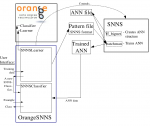 [/caption]
- Supports feed-forward, fully-connected multi-layer perceptrons with sigmoidactivation function.
- Is simpler than 0.99, as neural networks are evaluated in Python code.
- Does not leak memory.
- OrangeSNNS.py(version 0.99):
- Is more easily generalizable to all types of neural networks supported by SNNS, as the network code is generated by SNNS.
- Is supposed to be faster, as evaluation of network is .C code instead of Python.
- Is an example of how to dinamicly create, compile and use .C code from Python. Notice that it leaks memory by importing and unimporting modules . (I still don't know if it is a Python or Linux bug, or if I am not doing something necesary to free memory. Let me know if you have some news.) (Note: in the code, it is commented out a workarround that avoids memory leaking, but then, older networks may be used sometimes getting unreliable results)
- You can see its class and function definitions from help(orangeSNNS) .
[caption id="attachment_238" align="alignright" width="150" caption="Diagram showing how OrangeSNNS 0.99 works"]
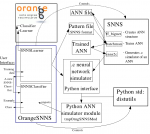 [/caption]


Use examples
- Create and train a neural network with default parameters (using bupa.tab as data). The network is used to classify the training set showing the predicted class for each example.
    import orange, orangeSNNS

    data = orange.ExampleTable("bupa.tab")

    learner = orangeSNNS.SNNSLearner()

    classifier = learner(data)

    for example in data:
       print example,
       print "->", classifier(example)
- Create and train a neural network:
- with two hidden layers the first with 2 neurons and the second with 3
- the training process will have 500 cycles on the training set.
- if MSE=0 is achieved training stops.
- the learning algorithm will be standard back propagation.
- the learning parameter is 0.2
The network is then used to classify the training set showing the predicted class for each example (using bupa.tab as data).
    import orange, orangeSNNS

    # We set the path where SNNS binaries can be found, this
    # is not necessary if they are in system path.
    orangeSNNS.pathSNNS = "~/SNNSv4.2/tools/bin/i686-pc-linux-gnu/"

    data = orange.ExampleTable("bupa.tab")

    learner = orangeSNNS.SNNSLearner(name = 'SNNS neural network',
                                     hiddenLayers = [2,3],
                                     MSE = 0,
                                     cycles = 500,
                                     algorithm = "Std_Backpropagation",
                                     learningParams = ["0.2"])

    classifier = learner(data)

    for example in data:
       print example,
       print "->", classifier(example)
Future plans
There will not be a 2.0 version, as this is just a quick solution. Instead, a completely integrated module with new code should be written, as SNNS is NOT free software and could not be adapted. More efforts on this module are worthless.
Probably a good choice to integrate neural networks in Orange is programming an interface to FANN .
There is a summer of code 2006 project (Neural Nets in SciPy) that may be interesting having an eye on it.